
I remember sitting down to the feature length pilot of Star Trek Voyager and after it was over, thinking, well here we go again. A Federation Starship, out there doing their best to get home, big deal!
I thought, “this show will probably rework old story ideas from the other series’ and then just fade away”. My problem was that I could not feel any empathy towards this crew, having got so used to Picard and his people over the past few years. This new crew were dysfunctional and confrontational, which at the time was a new concept for any programme bearing the name, Star Trek.
After a few weeks it became clear to me that the new show was beginning to take shape. The Doctor was becoming an increasingly interesting character and the rest of the dynamics were beginning to be explored by the writers.
By the time Seven of Nine, the former Borg drone joined the crew; a format that worked on many levels had evolved. It is only my own personal opinion but “I feel that Voyager became akin to the Waltons in terms of the relationships displayed by the crew”. The mother and father figures were clearly, the Captain and Chakotay. Tom Paris and B’Elana were like two of the older children who got married and had a child, thereby conforming to the wishes of their pseudo parents. Harry Kim was a little like John Boy Walton, looking at the world through an intelligent yet strangely naive perspective. Seven of Nine was like a wayward child needing a stable home to help her recognise and ultimately take the “right” path. Without labouring the point too much, Voyager was a marooned, extended family, triumphing against the odds. Some people might liken it to a kind of Waltons in space, this is why for me it will have added appeal as time goes by for many Star Trek followers.
The final episode of the series gives the strongest indication of all that the family orientated structure of many Voyager episodes was no accident. The Captain makes the ultimate sacrifice to get her crew/children home. I can not see the writers having Captain Kirk make this sacrifice, as it would not suit the tone of that show or the sex of the Captain perhaps?
It seems strange to me that the writers felt the need to create a Captain capable of such an act but unable to make this act of compassion, the act of a man. The main thing perhaps is that the act was written and performed by a Starfleet Captain as written by the creators of the Voyager series. This Captain was a great example to all Captains and leaders everywhere, whether they are male or female.
Where the new Star Trek series fails for me is that the lesson of the family orientated crew set up has not been repeated so far. This may be due to the Captain being written as a man or due to this new crew, only having spent a short time together?
If this “flaw” is not corrected soon, I feel that the show will fail to engage strong enough feelings in those who watch it to either survive, or create a place for itself alongside the earlier series in the minds of the viewing public.
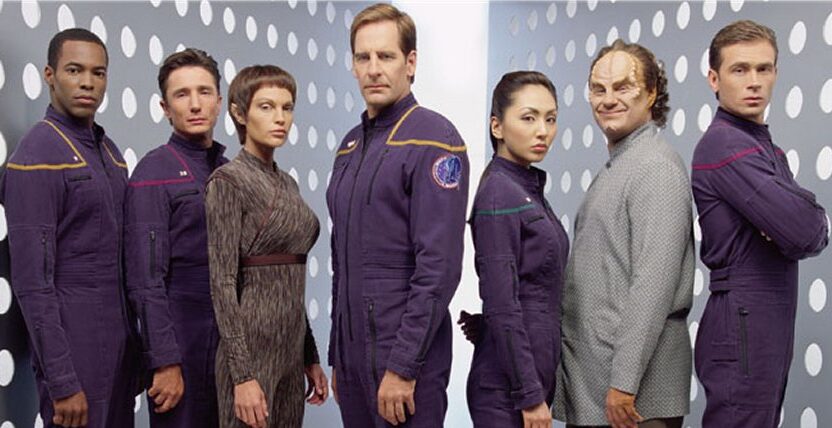
Captain Archer is for me too much like an older brother to his chief engineer and in fact the whole crew, he needs to take command a little more. If the character of Archer does indeed take command as I suggest, the level of drama will grow accordingly.
Kirk was a driven man as was Picard, Sisko had a well-developed spiritual side and was holding together a complex and potentially explosive political situation, Janeway had two crews with opposing views and attitudes but they all managed to command. Captain Archer needs to be forged in battle or tempered in some form of conflict o no one will wish to follow him week after week. We the viewing public must go on this journey ourselves or the show becomes static and predictable. Creating the prime directive and being the first to stick to it despite how hard it feels could prove to be the foundation of the challenge that Archer must endure. If he comes through it, the show will succeed as well.
I believe that Scott Bakula has the range and skill to pull off anything that is asked of him as an actor and so the show has a great chance to become successful. The only things that can stop this is the unwillingness or inability of the writers to take him and the show to the brink, and back.
The reason that I have chosen to compare these two shows is because aside from the obvious time difference, their format is not dissimilar. The Enterprise is virtually alone and away from home, as was Voyager, both crews need to decide on what type of code of ethics to employ, due to their circumstances and both crews are in uncharted waters.
I look forward to going where no man has gone before, throughout the next series of Enterprise, but hope that the stakes are increased next season.